
Small giving adds up, and kids know it
Ask a teacher what happens in classrooms this time of year and you’ll hear about coat drives, canned food contests, and plastic bags full of pop tabs headed to the Ronald McDonald House. A single pop tab is worth a fraction of a penny. Kids collect them by the thousands anyway, because they can watch the pile grow and they know where it’s going.
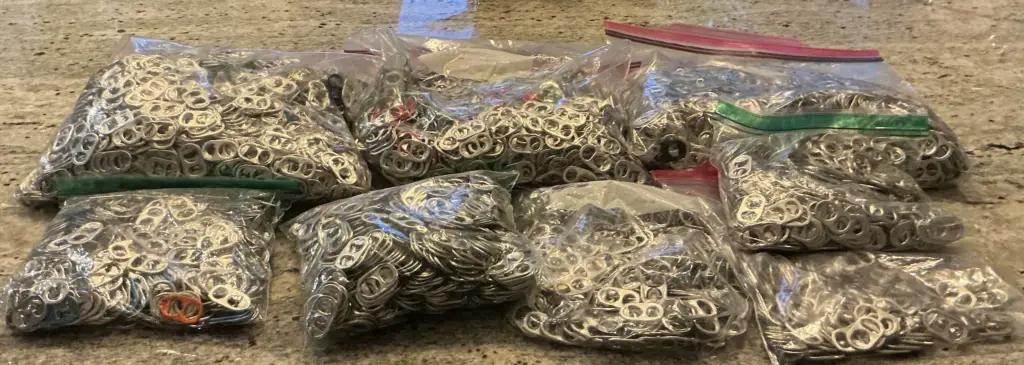
My son collected 5 lbs. of tabs for charity.
That’s worth paying attention to. Children don’t need a lecture on how small efforts add up. Give them a clear goal and a way to help, and many of them take it further than you’d expect. The child who fills a jar with tabs this year may organize a toy drive next year, or talk friends into sending leftover Halloween candy to troops.
If you’re a parent or grandparent, you probably want to encourage that instinct. You want your children to grow up generous because they care, not only because someone told them to. You can teach it on purpose, and Giving Tuesday, which falls on December 1 this year, is a good place to start.
Why talking about giving matters more than you think
Many parents assume that if they give, their kids will notice and follow. Research suggests that isn’t enough. A study from the Women’s Philanthropy Institute at Indiana University’s Lilly Family School of Philanthropy followed 903 children ages 8 to 19. It found that children whose parents talk to them about giving are 20 percent more likely to give than children whose parents don’t. Role-modeling alone was less effective than talking.
The effect held regardless of family income and regardless of the child’s age, gender, or race. In other words, the conversation is what makes the difference, not the size of the check.
This matters because a lot of giving happens out of sight. You might give through an online portal, a donor-advised fund, or a pledge set up years ago. Your kids may have no idea it’s happening, let alone why. If you want them to share your values, say those values out loud. Tell them which causes you support and how each one started. Maybe a relative was helped by a hospice, or you volunteered somewhere in college. Kids remember stories far longer than statistics.
Giving Tuesday 2026 and the case for giving close to home
Giving Tuesday is the Tuesday after Thanksgiving. In 2026 it falls on December 1. It started in 2012 as a counterweight to Black Friday and Cyber Monday, and it has grown fast. In 2025, 38.1 million Americans took part and gave $4.0 billion in a single day, a 13% increase over the year before.
For many nonprofits, this one day sets the tone for their year-end fundraising. That’s especially true for smaller local organizations. Food pantries, youth programs, shelters, senior services, and animal rescues in Metro Detroit often run on tight budgets and depend heavily on individual donors.
Local giving is also the easiest kind to teach. A child can’t picture a global relief fund. They can picture the food bank where they sorted cans last spring, the shelter that took in a neighbor’s dog, or the hospital where a classmate’s family stayed. When your kids can see where the help goes, the lesson sticks. They can visit, ask questions, and come back next year to see what changed.
The day itself has features that make it a good teaching moment. Many nonprofits line up matching donors for Giving Tuesday, so a $20 gift can become $40. Kids understand doubling right away, and it shows them that planning can make a gift go further. If your employer has a matching gift program, check whether it applies too.
Giving Tuesday is also a chance to show that giving isn’t only about money. Children can give time by volunteering, skills by making a poster or helping with a nonprofit’s social media post, and their voice by telling friends about a cause they care about. For a child without much money of their own, those gifts can feel just as real.
How kids can take part in charitable giving at every age
You don’t need to wait until your children are older to invite them to take part in charitable giving. What changes with age is how much they can understand and how much say you give them. The stages below follow guidance from The Philanthropic Initiative’s Raising Children with Philanthropic Values.
| Stage | What They’re Ready For | Ways to involve them |
|---|---|---|
| Ages 3 to 5 | Compassion and a sense of right and wrong are forming, but abstract ideas aren’t. Concrete, hands-on giving works best. | Pick out toys to donate at the holidays; keep a family giving box; read books about sharing |
| Age 6 to the early teens | They want to feel useful and start asking what some people have more than others | Set up an allowance with a portion for giving; run a bake sale or lemonade stand for a cause; by 10 or 11, research organizations to support |
| Teenagers | They’re working out who they are and can handle straightforward money conversations. Ideas that feel imposed may meet resistance | Volunteer with school, community or faith groups; budget their own expenses; pair with a relative or trusted advisor as a mentor |
The guide makes one point worth underlining: these habits are much easier to build in childhood than to start in young adulthood. Start small and early, and add more choice as your child’s interest grows.
Three habits that make giving stick
Whatever your children’s ages, a few habits help the lessons last beyond one Giving Tuesday.
- Follow their interests. A child who loves animals will care more about a shelter than a cause you picked for them. Start where their curiosity already is.
- Praise the effort, not the amount. A bag of Halloween candy and a large check both count. When children hear that their contribution mattered, they’re more likely to do it again.
- Keep going after December. Giving Tuesday is a good kickoff, but needs don’t follow the calendar. Put a spring volunteer day or a summer drive on the family calendar now.
Bringing your kids into bigger giving decisions
If your family gives through a donor-advised fund, a foundation, or gifts of appreciated stock, that giving can feel far removed from a child’s world. The planning side still matters, and starting your year-end giving early leaves time to get the timing, tools, and tax details right. The question here is different: how do you make that giving visible to your kids?
- Give each child a share to direct. Set aside part of your annual giving for children or grandchildren to recommend. Agree on a few ground rules first, such as local organizations only, or causes they can explain in their own words.
- Show them what comes back. Share the thank-you letters, impact reports, and photos that follow a gift. They connect the dollars to the people being helped.
- Talk about succession early. If you plan to name your children as successors on a fund or foundation, explain what the role means long before they take it on.
- Bring older kids to the table. Young adults can sit in on part of a planning meeting with your advisor to see how your family makes giving decisions.
None of this means sharing every detail of your finances. You decide how much each child sees.
What your kids will remember
Years from now, your children probably won’t remember the dollar amounts. They’ll remember the afternoon at the food bank, the conversation at the kitchen table, or the first time someone thanked them for something they did. Those moments shape the kind of adults they become.
Kids need an adult who takes their effort seriously and gives them a little room to run with it. This Giving Tuesday, try giving your children some of that room. Pick a local organization together, put real money or real time behind it, and talk about why it matters to your family.
Want help building a giving plan your whole family can be part of? At MKD Wealth, we help families organize their giving, choose the right tools, and bring the next generation into the conversation. [Schedule a conversation with our team]
Sources
- Women Give 2013: How parents teach children about charitable giving, IU Lilly Family School of Philanthropy
- Raising Children with Philanthropic Values, The Philanthropic Initiative (2015), via the National Center for Family Philanthropy
- GivingTuesday 2025 results, GivingTuesday
- Year-End Giving Starts in October, MKD Wealth

This material is for educational purposes only and is not intended to provide specific advice or recommendations for any individual and does not take into consideration your specific situation. There is no assurance that the views or strategies discussed are suitable for all investors or will yield positive outcomes. Investing involves risks including possible loss of principal. Be sure to consult with a qualified financial advisor, legal, and/or tax professional before implementing any strategy discussed here.
This material is for educational purposes only and is not intended to provide specific advice or recommendations for any individual and does not take into consideration your specific situation. There is no assurance that the views or strategies discussed are suitable for all investors or will yield positive outcomes. Investing involves risks including possible loss of principal. Be sure to consult with a qualified financial advisor, legal, and/or tax professional before implementing any strategy discussed here.