


Website & Messaging Privacy Policy | Designation Disclosures | Accessibility Statement
This website is for informational purposes only and does not constitute a complete description of our investment services or performance. This website is in no way a solicitation or offer to sell securities or investment advisory services except, where applicable, in states where we are registered or where an exemption or exclusion from such registration exists. Nothing on this website should be interpreted to state or imply that past results are an indication of future performance.
©2026 MKD Wealth Coaches, LLC. |All Rights Reserved|Website Developed by ARS Digital Marketing
©2026 MKD Wealth Coaches, LLC.
All Rights Reserved
Website Developed by ARS Digital Marketing
Executive Summary
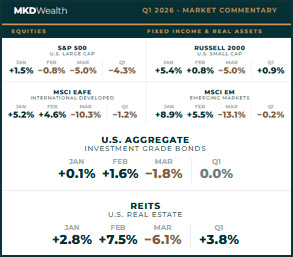
The first quarter of 2026 was defined by two distinct phases. January and February rewarded diversification as international equities, small caps, and real assets led the way while AI-related disruption rotated capital away from high-valuation U.S. software names. March reversed course sharply after Operation Epic Fury triggered a broad risk-off environment, rising oil prices, and renewed inflation fears. For the full quarter, the S&P 500 fell 4.3%, international markets gave back their early gains, and bonds were flat as rising yields in March offset earlier rallies. Portfolios with exposure across asset classes and geographies were better insulated from the late-quarter drawdown.
Market Review
January opened the year on a constructive note. The S&P 500 gained 1.5% for the month while small caps outperformed, with the Russell 2000 rising 5.4% as investors rotated into more attractively valued areas. International markets were the standout: MSCI EAFE advanced 5.2% and MSCI EM climbed 8.9%, led by South Korea, Mexico, and Brazil. AI-driven disruption was the dominant theme as the software sector fell 13.1%, while semiconductor companies abroad surged on hardware demand. The nomination of Kevin Warsh as the next Fed Chair added to the shifting policy backdrop.
February tested investors’ conviction. The S&P 500 slipped 0.8% for the month as AI-disruption anxiety continued to pressure expensive names, while the Russell 2000 held up with a 0.8% gain. International markets posted another strong month, with MSCI EAFE up 4.6% and MSCI EM up 5.5%. A lower-than-expected CPI print kept rate-cut hopes alive, and bonds rallied as the U.S. Aggregate returned 1.6%. REITs surged 7.5% on improved income-sector sentiment. Volatility picked up into month-end as events in the Middle East took center stage.
March brought a sharp reversal. Operation Epic Fury triggered broad risk-off sentiment and the S&P 500 fell 5.0% for the month, with energy the only positive sector as oil surpassed $100 per barrel. International markets bore the brunt: MSCI EAFE dropped 10.3% and MSCI EM fell 13.1%, hit by dependence on Middle East energy flows. Fixed income offered no shelter as inflation expectations pushed rates higher; the U.S. Aggregate declined 1.8%. REITs fell 6.1% with data centers as the lone positive subsector. Credit spreads widened on weaker labor data and growing concerns about slowing growth.
OPERATION EPIC FURY · FEBRUARY 28, 2026
On the final day of the month, U.S. and Israeli forces launched coordinated strikes on Iran targeting nuclear facilities, military infrastructure, and senior leadership. Iran’s Supreme Leader was killed. Retaliatory strikes have commenced. The situation remains fluid.
Geopolitical Context
Military action that results in civilian death and displacement is a grave humanitarian tragedy. We hope for a swift resolution. The affected region represents approximately 2.6% of global GDP, but the more consequential investment risk is transit. The Strait of Hormuz carries more than a quarter of global seaborne oil trade and roughly 20% of global LNG flows, with 84% of that LNG destined for Asia. Oil prices surpassed $100 per barrel in March following the closure of the strait, and the ripple effects on inflation expectations, interest rates, and global growth sentiment were felt across every asset class.
History’s pattern remains instructive: when conflict stays regional, the financial market impact tends to be transitory. With limited domestic appetite for prolonged military engagement and the political headwinds of elevated inflation ahead of midterm elections, we continue to expect a push toward resolution.
Portfolio Perspective
The quarter illustrated both the value and the limits of diversification in a single three-month span. Early leadership from international equities, small caps, and real assets gave way to a correlated selloff in March as geopolitical risk repriced markets broadly. Small-cap U.S. equities held up better than large caps for the full quarter (Russell 2000 +0.9% vs. S&P 500 -4.3%), and REITs remain positive year-to-date despite the March drawdown. Exposure across asset classes and geographies helped cushion the impact of a month in which very few areas were spared.
Looking ahead, we are going to keep an eye on the interplay between inflation, energy prices, and monetary policy. The Fed’s path is now more uncertain with rising commodity-driven inflation competing against signs of slowing growth. We believe diversified portfolios are well-positioned for this environment. Allocations across U.S. small cap, international developed, emerging markets, and real assets provide meaningful diversification away from large-cap U.S. equity concentration, while fixed income exposure helps anchor portfolios during periods of elevated volatility. That breadth proved valuable this quarter and we believe it will continue to serve clients well as the landscape evolves.
As always, we are here and available to discuss.
Disclosures
Comparisons to indices referenced herein are for illustrative purposes only. Indices cannot be invested in directly. Unmanaged index returns assume reinvestment of any and all distributions and do not reflect fees or expenses. Market returns are as of the publish date and sourced from Morningstar or FactSet unless otherwise noted. All investing involves risk including the potential loss of principal. This material is for informational purposes only and does not constitute investment advice. S&P 500: 500 large U.S. companies. Russell 2000: 2,000 smallest companies in the Russell 3000. MSCI EAFE: developed markets ex-U.S./Canada. MSCI EM: emerging market equities. Bloomberg U.S. Aggregate: U.S. investment-grade bonds. FTSE NAREIT Equity REITs: non-timber/infrastructure equity REITs.
Executive Summary
The first quarter of 2026 was defined by two distinct phases. January and February rewarded diversification as international equities, small caps, and real assets led the way while AI-related disruption rotated capital away from high-valuation U.S. software names. March reversed course sharply after Operation Epic Fury triggered a broad risk-off environment, rising oil prices, and renewed inflation fears. For the full quarter, the S&P 500 fell 4.3%, international markets gave back their early gains, and bonds were flat as rising yields in March offset earlier rallies. Portfolios with exposure across asset classes and geographies were better insulated from the late-quarter drawdown.
Market Review
January opened the year on a constructive note. The S&P 500 gained 1.5% for the month while small caps outperformed, with the Russell 2000 rising 5.4% as investors rotated into more attractively valued areas. International markets were the standout: MSCI EAFE advanced 5.2% and MSCI EM climbed 8.9%, led by South Korea, Mexico, and Brazil. AI-driven disruption was the dominant theme as the software sector fell 13.1%, while semiconductor companies abroad surged on hardware demand. The nomination of Kevin Warsh as the next Fed Chair added to the shifting policy backdrop.
February tested investors’ conviction. The S&P 500 slipped 0.8% for the month as AI-disruption anxiety continued to pressure expensive names, while the Russell 2000 held up with a 0.8% gain. International markets posted another strong month, with MSCI EAFE up 4.6% and MSCI EM up 5.5%. A lower-than-expected CPI print kept rate-cut hopes alive, and bonds rallied as the U.S. Aggregate returned 1.6%. REITs surged 7.5% on improved income-sector sentiment. Volatility picked up into month-end as events in the Middle East took center stage.
March brought a sharp reversal. Operation Epic Fury triggered broad risk-off sentiment and the S&P 500 fell 5.0% for the month, with energy the only positive sector as oil surpassed $100 per barrel. International markets bore the brunt: MSCI EAFE dropped 10.3% and MSCI EM fell 13.1%, hit by dependence on Middle East energy flows. Fixed income offered no shelter as inflation expectations pushed rates higher; the U.S. Aggregate declined 1.8%. REITs fell 6.1% with data centers as the lone positive subsector. Credit spreads widened on weaker labor data and growing concerns about slowing growth.
OPERATION EPIC FURY · FEBRUARY 28, 2026
On the final day of the month, U.S. and Israeli forces launched coordinated strikes on Iran targeting nuclear facilities, military infrastructure, and senior leadership. Iran’s Supreme Leader was killed. Retaliatory strikes have commenced. The situation remains fluid.
Geopolitical Context
Military action that results in civilian death and displacement is a grave humanitarian tragedy. We hope for a swift resolution. The affected region represents approximately 2.6% of global GDP, but the more consequential investment risk is transit. The Strait of Hormuz carries more than a quarter of global seaborne oil trade and roughly 20% of global LNG flows, with 84% of that LNG destined for Asia. Oil prices surpassed $100 per barrel in March following the closure of the strait, and the ripple effects on inflation expectations, interest rates, and global growth sentiment were felt across every asset class.
History’s pattern remains instructive: when conflict stays regional, the financial market impact tends to be transitory. With limited domestic appetite for prolonged military engagement and the political headwinds of elevated inflation ahead of midterm elections, we continue to expect a push toward resolution.
Portfolio Perspective
The quarter illustrated both the value and the limits of diversification in a single three-month span. Early leadership from international equities, small caps, and real assets gave way to a correlated selloff in March as geopolitical risk repriced markets broadly. Small-cap U.S. equities held up better than large caps for the full quarter (Russell 2000 +0.9% vs. S&P 500 -4.3%), and REITs remain positive year-to-date despite the March drawdown. Exposure across asset classes and geographies helped cushion the impact of a month in which very few areas were spared.
Looking ahead, we are going to keep an eye on the interplay between inflation, energy prices, and monetary policy. The Fed’s path is now more uncertain with rising commodity-driven inflation competing against signs of slowing growth. We believe diversified portfolios are well-positioned for this environment. Allocations across U.S. small cap, international developed, emerging markets, and real assets provide meaningful diversification away from large-cap U.S. equity concentration, while fixed income exposure helps anchor portfolios during periods of elevated volatility. That breadth proved valuable this quarter and we believe it will continue to serve clients well as the landscape evolves.
As always, we are here and available to discuss.
Disclosures
Comparisons to indices referenced herein are for illustrative purposes only. Indices cannot be invested in directly. Unmanaged index returns assume reinvestment of any and all distributions and do not reflect fees or expenses. Market returns are as of the publish date and sourced from Morningstar or FactSet unless otherwise noted. All investing involves risk including the potential loss of principal. This material is for informational purposes only and does not constitute investment advice. S&P 500: 500 large U.S. companies. Russell 2000: 2,000 smallest companies in the Russell 3000. MSCI EAFE: developed markets ex-U.S./Canada. MSCI EM: emerging market equities. Bloomberg U.S. Aggregate: U.S. investment-grade bonds. FTSE NAREIT Equity REITs: non-timber/infrastructure equity REITs.